
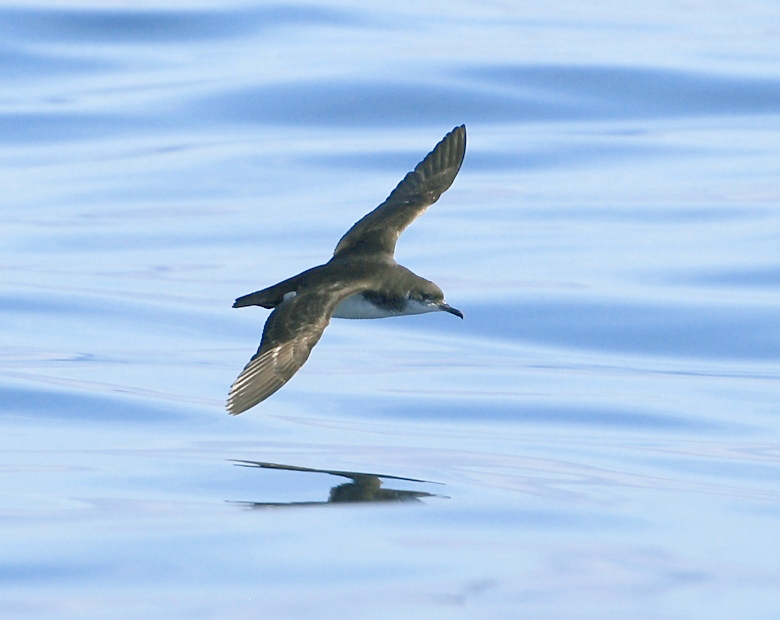
The birds recalibrate their internal clock at every dusk and dawn. This means that for every degree of longitude a bird covers between sunrise and sunset, its clock falls four minutes out of sync with local time. In consequence, a Manx shearwater misjudges where the Sun should be and veers off course clockwise when it flies east, or anticlockwise when it flies west.
Scientists had already shown something similar in other birds by catching penguins and quickly moving them across lines of longitude, but before Lewin’s study no one had clearly demonstrated it in wild animals moving on their own, mostly because the effect is small, and so requires a lot of data to become apparent. But Lewin’s team happened to have just the right database.
20 years of tracks
Tim Guilford, Lewin’s supervisor at Oxford, and Chris Perrins, a long-time Oxford shearwater researcher, started fitting shearwaters with GPS tags in 2004, when the devices first became small enough for a bird this size. Two decades later, the team had tracks from 3,688 foraging trips made by 1,045 birds from colonies along the UK’s western coasts. Those trips last from one day up to two weeks.
From this dataset, Lewin and his colleagues separated homeward flights, which the scientists say was rather simple. Foraging shearwaters make short, wiggly flights between dives. “When they are deciding to go back to their colony, they kind of switch into this mode where they are flying as fast as they can in pretty much a straight line continuously without stopping for really long periods,” Lewin said.
For each homing flight, the researchers worked out where the bird last saw the sunrise, at which point its clock should have matched local time. Then, at every GPS fix, they calculated how far east or west it had traveled since, and how much that would bend its Sun compass. Since they knew each bird was headed exactly to its burrow, they could compare those predictions with how the birds actually deviated from their course.